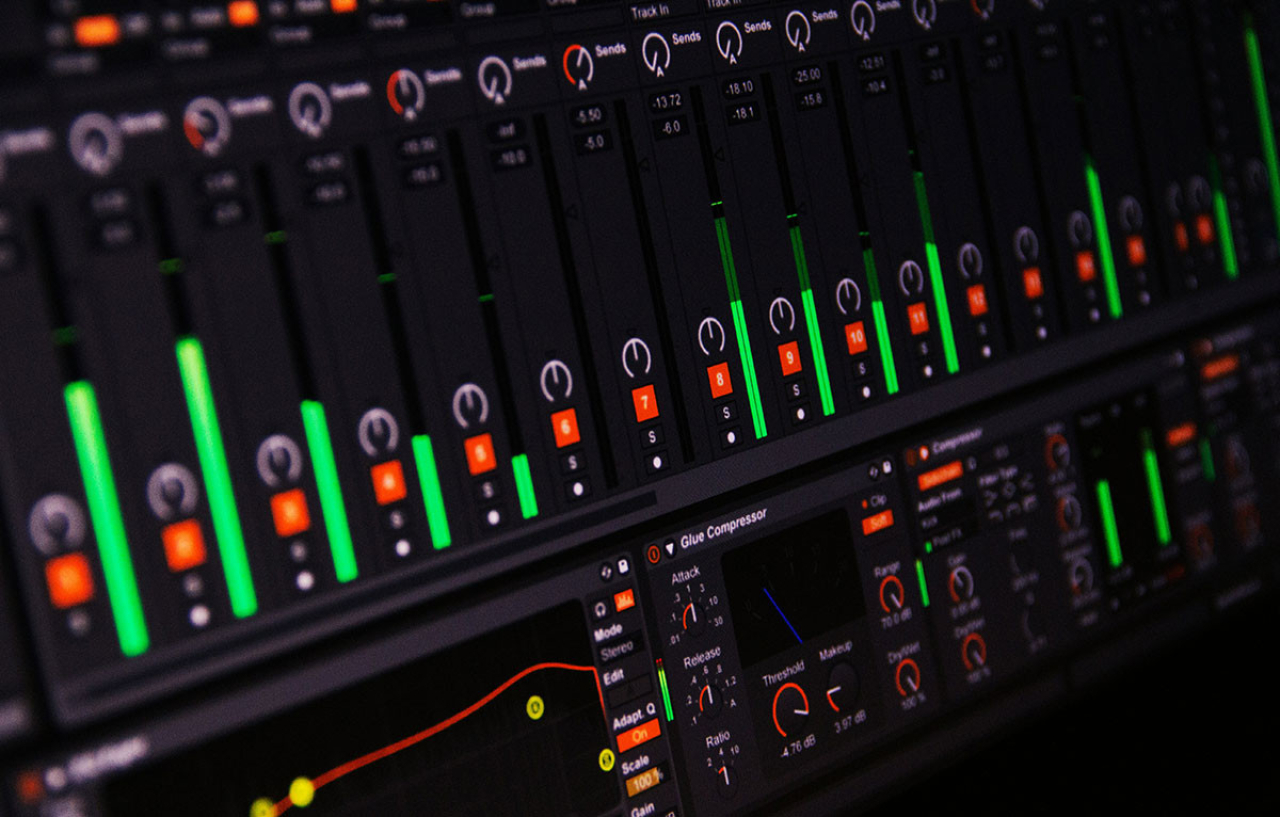
Understanding these stages can make the production process more organized and help artists avoid trying to solve every problem at once.
1. Songwriting and the Initial Idea
Every production starts with an idea. It might be a chord progression, vocal melody, guitar riff, drum groove, sample, or even just a particular atmosphere the artist wants to create.
At this stage, the goal is not necessarily technical perfection. It is about establishing the identity of the track. Producers may experiment with tempo, key, rhythm, instrumentation, and different melodic elements until the basic direction becomes clear.
For electronic music producers, this stage may happen entirely inside a DAW. A simple eight-bar loop containing drums, bass, chords, and a lead can become the foundation for a complete song. In more traditional productions, songwriting may happen first with vocals, piano, guitar, or another instrument before recording begins.
2. Arrangement and Structure
Once the main musical ideas are established, they need to be developed into a complete arrangement.
Arrangement determines how the song progresses over time. Depending on the genre, this could involve verses, choruses, bridges, intros, breakdowns, drops, builds, and outros.
Good arrangement is largely about controlling energy and maintaining the listener's attention. Elements can be introduced gradually, removed temporarily, or modified throughout the track to create contrast.
For example, a producer might remove the bass before a chorus or drop to make its return feel more powerful. A percussion layer may appear only during later sections, while melodies can change slightly each time they return.
Even relatively repetitive genres benefit from thoughtful arrangement. Small variations in drums, automation, effects, or instrumentation can prevent a track from feeling static.
3. Sound Design and Instrument Selection
The next part of the process involves shaping the actual sonic character of the production.
This may include selecting samples, programming synthesizers, recording instruments, layering sounds, editing drum hits, and designing effects. Producers working with electronic music may spend considerable time adjusting oscillators, filters, envelopes, distortion, modulation, and other synthesis parameters.
However, sound selection is often just as important as sound design.
Two individually impressive sounds may not work well together if they occupy the same frequency range or compete for attention. Choosing complementary sounds early can dramatically simplify the mixing process later.
A well-selected kick and bass combination, for example, may require much less corrective processing than two sounds that naturally clash.
4. Recording and Editing
Productions involving vocals or acoustic instruments normally require a dedicated recording stage.
The objective is to capture clean performances with appropriate microphones, recording levels, room acoustics, and positioning. Multiple takes may be recorded so that the strongest parts can later be combined.
Editing follows the recording process. This can involve cutting unwanted noise, selecting the best takes, correcting timing issues, adjusting fades, removing clicks, and organizing recorded material.
Vocals may also receive pitch correction where appropriate, while drums and other instruments can be tightened rhythmically.
Editing should ideally create clean source material before serious mixing begins. Trying to repair poorly edited recordings using compressors and EQ later often introduces unnecessary complications.
5. Mixing the Track
Mixing is where all individual elements are combined into a coherent stereo production.
The process usually begins with basic levels and panning. The producer or mixing engineer decides which sounds should dominate and which should remain in supporting roles.
EQ can then be used to control frequency balance and reduce conflicts between instruments. Compression helps manage dynamics or alter the character of particular sounds. Reverb and delay create depth and space, while saturation and distortion can add harmonics, warmth, aggression, or texture.
Automation is another important part of modern mixing. Volume, effects, filters, panning, and other parameters can change throughout the song to keep the mix dynamic.
The objective is not simply to make every instrument clearly audible. A good mix creates hierarchy. Some elements deliberately sit behind others, while the most important musical components attract the listener's attention.
Preparing the Final Mix
Before mastering, the producer should make sure the mix itself is genuinely finished.
Problems such as an excessively loud vocal, weak kick, harsh cymbals, or muddy low end should generally be addressed during mixing rather than left for mastering.
It is also useful to check the track on several playback systems. Studio monitors may reveal detail, while headphones, consumer speakers, a car system, or even a phone can expose balance problems that were less obvious in the studio.
Reference tracks can also help establish whether the tonal balance, stereo width, bass response, and overall energy are appropriate for the genre.
The final premaster should normally be exported at a high-quality resolution without unnecessary lossy compression.
6. Mastering: The Final Stage
Mastering is the final technical and creative stage before distribution. Rather than concentrating on individual instruments, mastering treats the finished stereo mix as a complete piece of audio.
A mastering engineer may make subtle adjustments to tonal balance, dynamics, stereo image, transient response, and perceived loudness. Processing can involve equalization, compression, saturation, clipping, limiting, or other specialized tools, but the exact chain depends entirely on what the mix requires.
Modern artists can work with a local engineer or use professional mastering online services, which make it possible to send finished mixes to specialized mastering studios regardless of location.
Mastering also considers consistency. When several songs are being released together as an EP or album, they should feel related in loudness, frequency balance, and overall presentation even if they were produced at different times.
Finally, the master is prepared according to the technical requirements of its destination, whether that means streaming platforms, digital downloads, CD, vinyl, or another format.
A Process Where Every Stage Matters
Strong productions are usually the result of many small decisions rather than one dramatic final improvement. Good mastering cannot completely rescue a weak mix, just as good mixing cannot fully compensate for poor arrangement or inappropriate sound selection.
Treating songwriting, arrangement, sound design, recording, editing, mixing, and mastering as separate but interconnected stages makes it easier to concentrate on the right problem at the right time.
When each stage is handled carefully, the final master becomes what it should be: the finishing step that enhances an already successful production and prepares it for listeners.